
Microdialysis Technique
| Question: | What is recovery? |
| Answer: |
The recovery of a particular substance is defined as the concentration in the dialysate expressed as percent of the concentration in the interstitial fluid.
|
| Question: | How does the length of the membrane affect the recovery? |
| Answer: |
A longer membrane and a lower flow rate will give a higher recovery.
|
| Question: | How shall the perfusion fluid be composed? |
| Answer: |
Ideally it should be as close as possible to the composition of the extracellular fluid. However, you may want to change the concentration of sodium, potassium or calcium in order to influence the membrane function in the region you are studying.
|
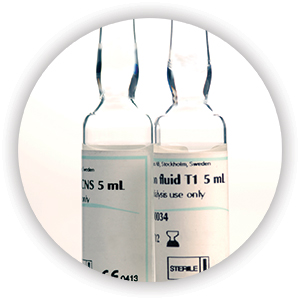
| Question: | What is the pH of the CNS perfusion fluid? |
| Answer: |
The CNS perfusion fluid is intentionally not buffered in order to allow it to take on the same pH as the brain’s interstitial fluid. The pH of a non-buffered solution varies between 5-8.
|
| Question: | How does the pH of the CNS perfusion fluid impact the tissue? |
| Answer: |
Since our perfusion fluid is unbuffered it can hardly itself impact the pH in the tissue. The perfusate will take on the same pH as the surrounding tissue. But the buffered substances in the tissue can have different recovery over the membrane which indirectly can have a small effect on the pH of the tissue.
|
| Question: | If the cut-off of the probe membrane is 20,000 Daltons, why do I not have 100% recovery for molecules of 20,000 Daltons? |
| Answer: |
The ability of molecules to pass the membrane decreases logarithmically with the increase in molecular weight. By experience we know that most substances with a molecular weight up to 5,000 Da can be dialyzed when using a 20,000 Da membrane. This is of course very dependent on the substance and the sensitivity of the analytical method.
|
Probes
| Question: | Which length of the microdialysis probe membrane shall I use? |
| Answer: |
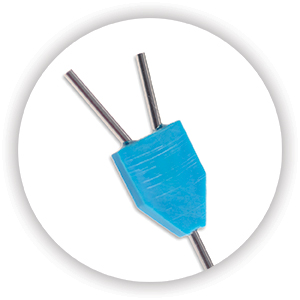
A longer membrane gives a better recovery of the substances you are interested in but the choice is usually limited by the size of the structure you want to study.
|
| Question: | Which membrane material is to be recommended? |
| Answer: |
A membrane with low cut off purifies your sample by excluding large molecules. A membrane with high cut off recovers large substances such as peptides or smaller proteins. Note that some substances can also bind to the membrane material. To optimize your choice you should make an in vitro test with the substance you want to monitor.
|
| Question: | You have a number of different Microdialysis probes? How shall I choose the right one for my experiment? |
| Answer: |
There are of course many aspects which determines the choice. This is a brief overview, for more information see our catalog or product information on CMA web pages.
|
| Question: | What perfusion flow rate should be used? |
| Answer: |
A high flow rate if you want to remove or introduce as many molecules as possible per time unit.
|
| Question: | What time is needed to obtain steady state conditions? |
| Answer: |
The introduction of a probe into the tissue will always cause damage and the recovery of function will take a certain time period. An hour is often used to reach “baseline conditions”.
|
| Question: |
Are the probes reusable? |
| Answer: |
The preclinical probes can be used repeatedly if rinsed and stored in deionized water between experiments. However CMA can only guarantee single usage.
|
| Question: | When do I need the guides? |
| Answer: |
Guides are used when you shall perform Microdialysis in the brain of a freely moving animal.
|
| Question: |
How do I handle FEP tubing and Tubing adapters? |
| Answer: |
When using a FEP tubing you shall cut the tubing with a sharp scalpel or similar to be sure the ends are open. After use rinse it with de ionized water to wash out the salts.
|
| Question: |
I get faulty flow. What have I done? |
| Answer: |
Maybe you have not calibrated the pump to the syringe you are using.
|
| Question: |
Why do I get faulty volume of my microdialysis sample? |
| Answer: |
The probe may be leaking, the tubing may be blocked, something may be wrong with the pump, or the tubing adapters may be leaking.
|
Instruments
| Question: | What is the difference between the CMA 400 pump and the CMA 402 pump? |
| Answer: |
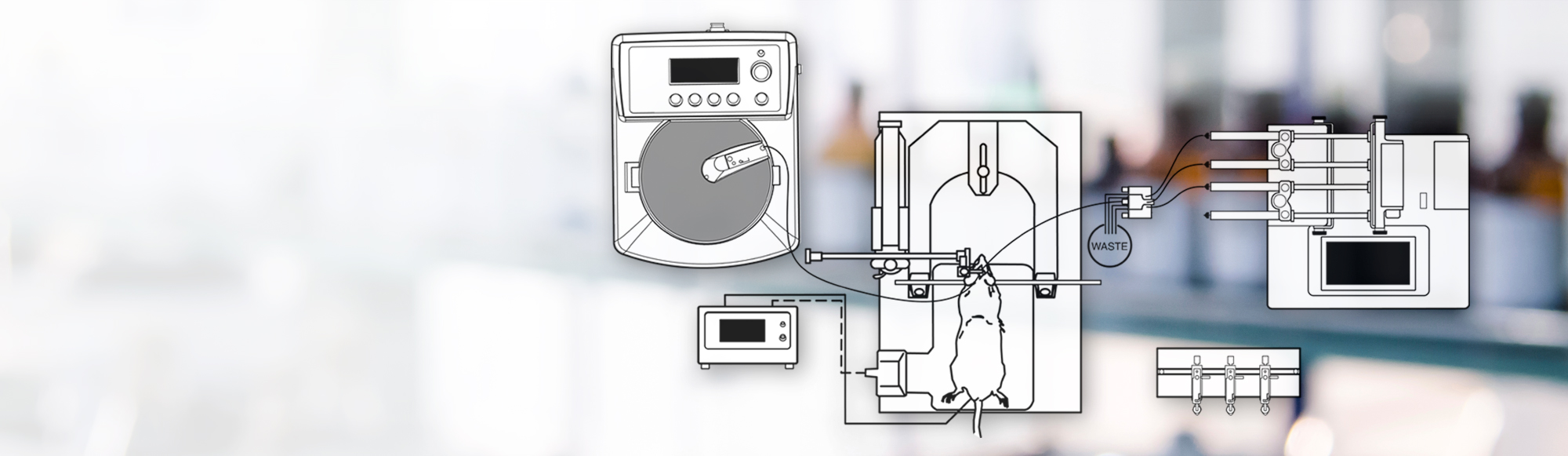
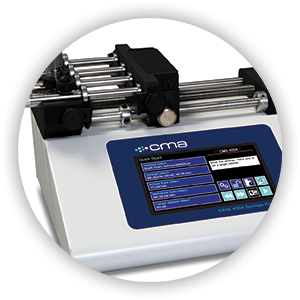
CMA 400 has a pulse free flow from 1 nL/min - 1 mL/min, runs four syringes simultaneously. The pump is calibrated for various sizes of syringes. Apart from microdialysis experiments, it can be used for microinjections of preset volumes that can be repeated in intervals.
|
| Question: | What is the difference between CMA 142 and CMA 470 Fraction Collectors? |
| Answer: |
The CMA 142 collects fractions from 1 probe, 20 fractions or from 2 probes, 10 fractions. Fraction volumes from 1uL - 50 uL in open vials.
|
| Question: |
When shall the CMA 150 be used? |
| Answer: |
The CMA 150 keeps a stable temperature of the animal during an anesthetized microdialysis study. This ensures a better quality of your study.
|
| Question: | What is the use of a CMA 120 System for Freely Moving Animals? |
| Answer: |
This system enables Microdialysis studies on conscious, small laboratory animals over a long period of time. It can be used in combination with any one of CMA’s preclinical instruments.
|